

Dearest Reader,
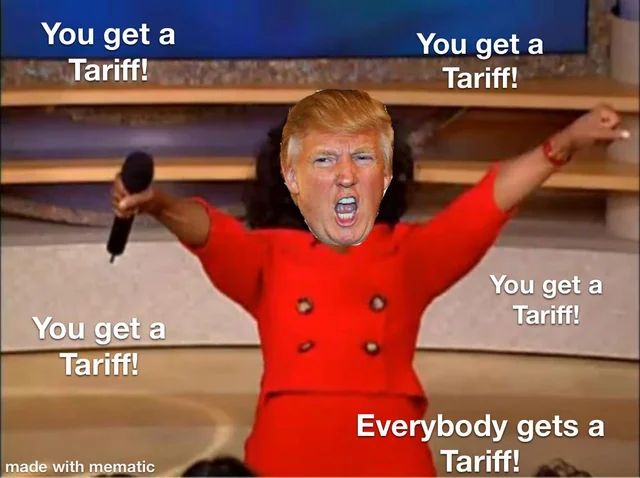
It seems like every time you blink, President Trump has signed a new executive order and unleashed a new tariff. Can someone please hide all the pens in the white house?
You're probably wondering: how does all of this affect me, and why should I care? After all, I'm Canadian. In today's Newsletter, I'll break everything down.
Let's start with what's been happening.
What's with the tariffs?
Imagine you have a lemonade stand and buy your lemons from your friend who lives in another country. One day, your country decides to charge you extra money every time you purchase lemons from that country, kind of like a penalty. That extra charge is called a tariff.
Tariffs are like taxes on things we buy from other countries. The government adds these taxes to make imported stuff more expensive, so people might choose to buy things made in their own country instead. But sometimes, that means prices go up for everyone because even if you start producing the lemons in your country, you might still need to import the wood used to make the lemonade stand, the glass jugs and cups used to serve the lemonade and even the trucks used to transport the lemons to the grocery store or the netted bags used to bag them. So, at the end of the day, costs will still go up.
Recently, the U.S. imposed a universal 10% tariff on all imports with additional country-specific tariffs affecting over 90 countries, including Canada, China, Australia, and even the Penguins. So these countries said, bet, you tariff me, I tariff you, and now everything, everywhere, is about to get real expensive, and it's all become one big hot mess.

How it led to a trade war
When both sides start raising tariffs in response to each other, you get a trade war. And that’s where we are now. This tit-for-tat policy has strained relationships with trading partners, disrupted global supply chains, and shaken investor confidence. Businesses facing higher costs are either cutting back, raising prices, or laying off workers, all of which slows economic momentum.
How it caused the stock market to tank
Markets hate uncertainty. The Trump administration announced it would impose new tariffs on 90 countries beginning April 7th. In anticipation of the mayhem unfolding with retaliatory tariffs, investors lost confidence in the stock market, which took a huge hit. On Monday, many investors woke up seeing red on their portfolios as the S&P500 declined by 13.9% for the year, which led to widespread panic.
Now that you're all caught up let's address the questions that are on your mind:
How will all of this affect me?
Even if you don’t actively trade stocks, the ripple effect is real. You might feel it through:
- Higher prices on consumer goods (especially imported ones)
- A weaker job market if businesses start cutting costs. Expect another wave of massive layoffs
- A dip in your investment portfolio
- A potential bear market or recession. We don't know how long this will last*
- Loan rate shifts if central banks try to stimulate the economy through rate cuts
Should I sell my investments for now?
In most cases, no. When you sell during a dip, you lock in your losses. If you’re investing for the long term and your portfolio is diversified, riding out the storm is usually better than panic-selling. That said, if you have any short-term investments, now would be a good time to assess your risk level and rebalance your portfolio if necessary.
Should I move to bonds instead?
Some investors shift their portfolios to bonds or cash during market uncertainty because bonds tend to be the "safer" investment with less volatility, but that isn't always the case. First, we have to look at the factors that affect the price of bonds. One of those is interest rates. When interest rates increase, bonds tend to decrease. We saw this during the pandemic when the Bank of Canada increased rates to fight inflation, and both the stock and bond markets fell. With the trade wars, which would increase the cost of goods, we might see inflation go up again, and interest rates could go up, which will also negatively impact the bond market. So, unless you need access to your money soon, it is better to stick to your original portfolio.
But is now a good time to enter the market?
If your dream house that has been out of your budget suddenly dropped its asking price, would you still buy it? If you have cash to invest and a long-term horizon, this could be an opportunity to purchase ETFs at a discount.
Just make sure:
- You have an emergency fund in place so that you can leave your investments alone
- You’re not investing money you’ll need in the next 3–5 years (because we don't know how long this will last*)
- You invest consistently, not all at once (a.k.a. dollar-cost averaging)
So I guess we should buy the dip?
The consensus is that stocks are on sale, so why not buy more? I recommend you pause and look closer at how the tariffs will affect that company before buying more of their shares. These tariffs could send many businesses bankrupt or cause them to lose a massive chunk of their profits. So, while the entire stock market typically recovers, not all stocks recover from a crash or will survive the tariffs.
If you have ETFs that invest in the entire market, buy the dip. If you have individual stocks, evaluate them before you buy.
*Update: As of Wednesday evening (before I wrote this Newsletter 🙄🙄), Trump has paused tariffs on 90 countries, except China, for another 90 days.
What's happening inside the society
The Surplus Stack Society launched in March with 18 new members 🎉🎉. The transformations we have seen in such a short time have been epic, so let's get into it.
Diamond of the season:

Our Diamond of the Season is Petra Gordon! In March, Petra:
- Uncovered her 30% Surplus
- Graduated from a Debutante to a Baroness
- Paid off $7,088 of debt
Congrats to Petra on all her accomplishments.
Wins of the month
Here are some of the wins that members of SSS have had:
- Paid a lump sum on my high-interest credit card
- Started investing overseas, tightened our eating out spending and stayed within range
- Invested while still overspending
- Added $3,500 to my emergency fund
- I was generous. I sowed into a Ministry
- Got a 10k tax return that went directly into my savings for my house fund
- Maxed out my TFSA and FHSA
- Put my non registered $$ back into my RRSP. And heavily front-loading my TFSA
One challenge completed
We just wrapped up the 30% Surplus in 30 Days Challenge. This is a challenge to help you uncover the limiting beliefs that are holding you back from your Surplus and build and refine your money system to bring you closer to your 30% surplus and beyond. Many of our members not only saw their surplus jump but also discovered many ways that they have been subconsciously playing small and blocking their abundance. It was so good I decided to give you a sneak peek by creating a free version - Sprint to Surplus Challenge.
Join the sprint to surplus challenge
This month's challenge is to "Save One Paycheque in One Month," and some have already reached their goal
Testimonials
We asked our members what they have gained since they joined the SSS, and here are the responses:
- Learning that I have had 30% surplus income all along. Calculated the numbers. Learning that the things I have been doing since last year are align with what is being taught in SSS. Feeling in control of my money and that my financial goals are possible to achieve.
- A better idea of my money triggers and overall money mindset.
- I love the back and forth in the community
- Learning to let myself spend a little more on my health. Moving from a scarcity mindset.
- Community. Likeminded women
- Increased encouragement to reach my financial goals
- The feedback on important topics from other members, and their support. I loved the podcast episodes on mindset around money. It really challenged me and made me change my perspective
The Surplus Stack Society is a money membership for high-achievers who want to have more than 30% of their income left over every month, be debt-free, grow their investments to 10X their annual income, and live every day with ease. We use the SURPLUS method to give you the tools, systems, and guidance you need to increase your surplus, build your savings, pay off debt, and go from investing 1X your annual income to 10X your annual income.
Join the Surplus Stack Society




Responses